

If you're a business owner in Austin looking to build or redesign your website, one of the first questions you’ll ask is:
“How much is this actually going to cost me?”
The short answer: Most custom websites in Austin range from $2,500 to $15,000+
But that range is wide for a reason.
In this guide, we’ll break down what you can expect to pay in Austin, what actually drives website pricing, and how to make the right investment for your business. Whether you're exploring a full custom build or browsing different website design services, understanding pricing upfront can help you avoid costly mistakes.
Average Website Cost in Austin (2026)
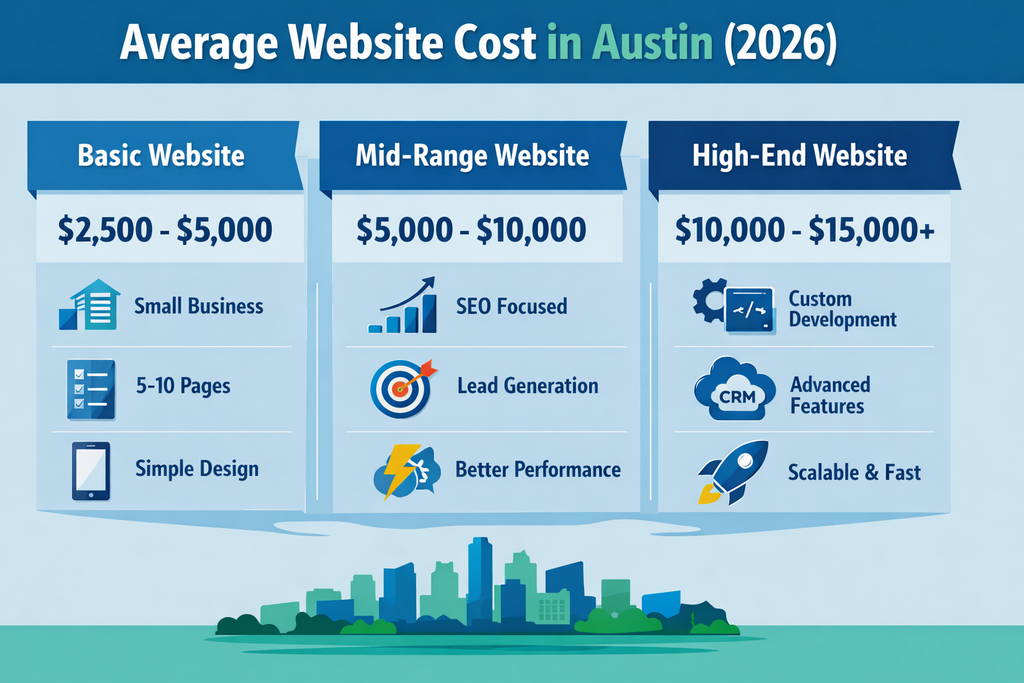
Website pricing can vary significantly depending on the scope, but here’s a realistic breakdown for the Austin market:
Basic Website ($2,500 to $5,000)
Best for:
- Small service businesses
- Simple brochure-style sites
- 5 to 10 pages
Typically includes:
- Template or semi-custom design
- Basic mobile responsiveness
- Light SEO setup
Builds at this level often rely on templates. That can work for getting online quickly, but it limits how much the site can grow with your business later.
Mid-Range Website ($5,000 to $10,000)
Best for:
- Growing businesses
- Companies investing in SEO
- Lead generation focus
Typically includes:
- Custom design tailored to your brand
- Conversion-focused layout
- On-page SEO optimization
- Faster performance and better UX
This is where most small business websites begin to see real ROI, especially when they’re built with both design and marketing in mind.
High-End Website ($10,000 to $15,000+)
Best for:
- Competitive industries
- Businesses relying heavily on web leads
- Advanced functionality
Typically includes:
- Fully custom design and development
- Advanced SEO strategy
- Custom integrations (CRM, booking, etc.)
- Performance optimization and scalability
What Actually Affects Website Cost?
Not all websites are created equal, and pricing reflects that. Here are the biggest factors that impact cost:
Design Complexity
A basic template is quick and affordable, while a fully custom design requires strategy, UX planning, and significantly more build time. Today, some businesses are also exploring newer approaches like AI website design, which can offer a faster starting point but still benefit from customization and strategic oversight.
Number of Pages
More pages mean more design, development, and SEO work. A 5-page site is very different from a 25-page structure that includes multiple services, locations, and supporting content.
SEO and Content Strategy
This is one of the biggest differences between a website that just exists and one that actually performs. A properly optimized website includes keyword targeting, page structure, internal linking strategy, and optimized headings and metadata.
This is where strong digital marketing services come into play, helping ensure your website is positioned to rank and generate leads over time.
Functionality and Features
Costs increase if you need booking systems, payment integrations, membership areas, custom forms or automations, etc.
Who You Hire
Your cost will vary depending on who you work with:
- Freelancer: Lower cost, more variability
- Small agency: Balanced cost and quality
- Large agency: Higher cost, more overhead
Reviewing real-world examples can help set expectations, which is why browsing a company’s client portfolio is often one of the best ways to understand what different investment levels actually look like.
Cheap Websites vs Quality Websites
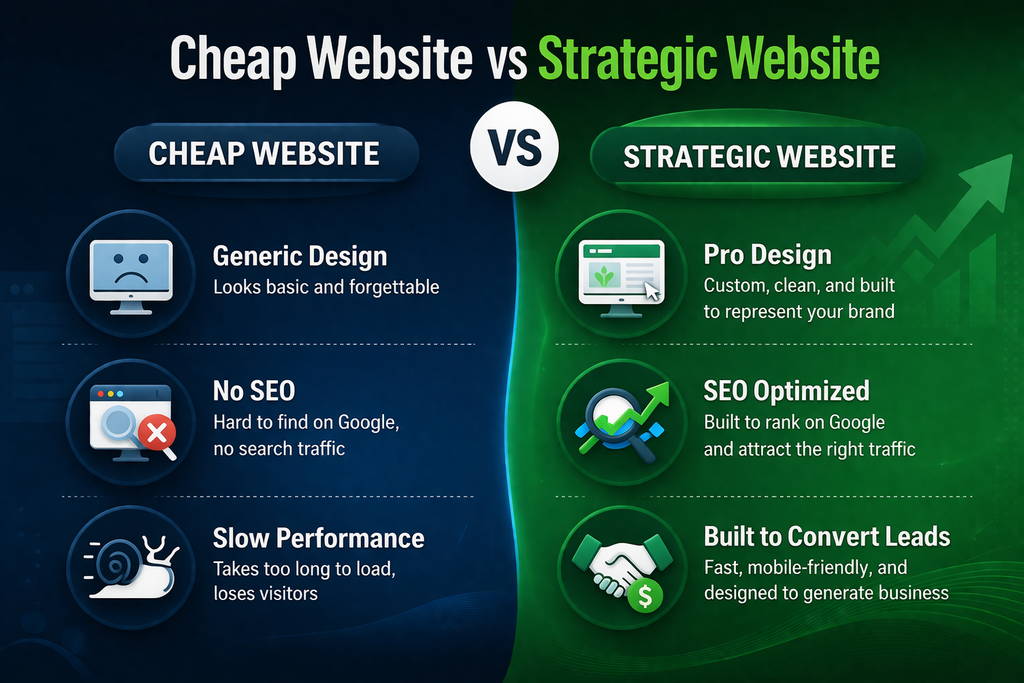
It’s tempting to go with the lowest price, but here’s what usually happens:
Cheap Website ($500 to $2,000)
- Generic design
- Little to no SEO
- Slow performance
- Minimal conversion strategy
The result is usually a site that looks decent on the surface but fails to generate meaningful business.
Strategic Website ($5,000+)
- Designed to convert visitors into leads
- Built with SEO in mind
- Fast, mobile-optimized (especially important with modern mobile website design standards)
- Scalable as your business grows
This is where a website starts functioning as a true marketing asset instead of just an online placeholder.
What’s the ROI of a Website?
A website isn’t just an expense, it’s one of your most important long-term investments.
For example:
- Your average job = $1,500
- Your website generates 3 additional leads per month
- You close just 1 of those
That’s $1,500 per month or $18,000 per year.
Compared to the cost of a professionally built website, the return becomes clear over time.
How to Choose the Right Budget
Here’s a simple way to think about it:
- Just need an online presence? Lower range
- Want consistent leads? Mid-range
- Want to dominate your market? Higher investment
The key is aligning your website with your business goals, not just choosing the cheapest option.
If you're unsure what direction to take, it can help to contact a local web design expert to better understand your options and avoid unnecessary spending.
Why Austin Website Pricing Is Different
Austin is a fast-growing and competitive market. That means more businesses investing in SEO, higher expectations for design quality, and greater competition for Google rankings. In many industries, a basic website simply isn’t enough to stand out anymore.
Final Thoughts
There’s no one-size-fits-all price for a website, but there is a right investment level for your business. The goal isn’t to get the cheapest website. It’s to get a website that actually works. If you're comparing options or trying to better understand what goes into pricing, reviewing a detailed website pricing breakdown or learning more about our team and approach can help you make a more confident decision.
FAQs: Website Costs in Austin
How much should a small business spend on a website in Austin?
Most Austin small businesses should plan to invest between $3,000 and $8,000 for a professional, custom website. That range typically covers a custom design built for mobile devices, a clear page structure, foundational SEO, and testing across devices before launch. Simpler sites with only a few pages land toward the lower end, while sites with more service pages, custom features, or written content land higher. Spending well below that range usually means a template with little strategy, which often costs more later when the site has to be rebuilt.
Why do some websites cost only $500 while others cost $10,000 or more?
The price gap comes down to how much strategy, customization, and performance work goes into the build. A $500 website is usually a template filled in with your logo and text, with little SEO setup and no plan for turning visitors into leads. A $10,000 website typically includes discovery and planning, a custom design, more pages written around what customers search for, speed tuning, and testing on every device. You are paying for a website built to bring in business, not just one that exists online.
Is it worth paying more for SEO during a website build?
Yes, building SEO into a website from the start is one of the most valuable parts of the investment. SEO during the build means a clean page structure, a logical URL plan, proper headings, fast load times, and pages written around the terms your customers actually search for. Adding these after launch often means reworking pages that are already live. A website without that foundation can look great and still struggle to show up on Google, which defeats much of its purpose.
How long does it take to see a return on investment from a website?
Many businesses begin seeing a return from a new website within 3 to 6 months, especially when SEO is part of the build, though the timeline depends on your industry, competition, and marketing. Google needs time to crawl, index, and trust new pages, so organic leads usually grow gradually rather than overnight. Paid ads or an existing customer base can show results sooner. Over time, a well-built website becomes one of your most reliable marketing tools because it keeps generating leads without ongoing ad spend.
Can I start with a smaller website and upgrade later?
Yes, starting with a smaller, well-built website and expanding it later is a smart approach for many small businesses. The key is a foundation that can grow, such as a custom WordPress website with a page structure and SEO plan that leave room for new service pages, service areas, or blog content. Built that way, you can add pages as your business grows without starting over. A cheap template website, by contrast, often has to be rebuilt from scratch once you outgrow it.
What ongoing costs come with a website after launch?
A website’s ongoing costs typically include hosting, a domain name renewal, software or plugin licenses, security updates, and backups. These keep the site fast, secure, and online, and skipping them is one of the most common reasons small business websites break or get hacked. Many businesses bundle this work into a monthly plan instead of managing it themselves. At Austin Custom Web, hosting and maintenance are covered through our Ongoing Website Care Plans. If you want to keep growing search traffic, budget for SEO or content work separately. See our pricing page for details.