

A great small business website needs to do much more than look professional. It should clearly explain what your business does, establish trust, make it easy for potential customers to find what they need, and ultimately turn more visitors into leads or customers.
For small businesses competing in a market like Austin, those fundamentals are especially important. Potential customers can compare several businesses within minutes, and your website is often one of the first places they decide whether your company feels credible and worth contacting. Good website design brings together appearance, usability, content, SEO, speed, and conversion strategy rather than treating them as separate pieces.
Start With a Clear Purpose
Before worrying about colors, animations, or other design details, a small business website needs a clear purpose. A visitor arriving on your homepage should quickly understand who you are, what you offer, who you serve, and what they should do next.
This sounds simple, but many websites make visitors work too hard to figure out what the company actually does. Clear headlines, concise supporting content, intuitive navigation, and strategically placed calls to action can make a website significantly easier to use. Our approach to small business websites starts with these business goals before moving into the finer details of design.
Professional Design Builds Trust
People make judgments about businesses quickly, and the quality of a website contributes to that first impression. An outdated or poorly organized website can make an otherwise excellent company appear less established, while a polished website helps reinforce professionalism and credibility.
Professional design does not mean filling every page with elaborate effects. In many cases, the strongest websites use thoughtful spacing, consistent typography, quality photography, clear visual hierarchy, and restrained use of animation. The design should reinforce the company's brand while keeping the visitor's attention focused on the content and services that matter.
Looking through a company's website design portfolio can be useful because it shows whether the designer can create professional websites for different businesses rather than repeatedly applying the same template.
Mobile Design Has to Be Part of the Foundation
A small business website should provide an excellent experience whether someone visits from a desktop computer, tablet, or mobile device. Mobile visitors should be able to read content, navigate menus, view images, complete forms, and contact the business without fighting against the design.
Responsive design is particularly important for local businesses because customers frequently search from their mobile devices when they are actively looking for a service. An Austin homeowner searching for a roofer, dentist, landscaper, or remodeling contractor may move directly from a Google search to a company's website and then to a phone call. A poor mobile experience introduces friction at exactly the point where that visitor may be ready to become a customer.
That is why mobile website design should be considered throughout the design process rather than added as a final adjustment after the desktop site is finished. We cover this in more detail in our article on why mobile-friendly website design matters.
Your Website Should Be Built for Search Engines and People
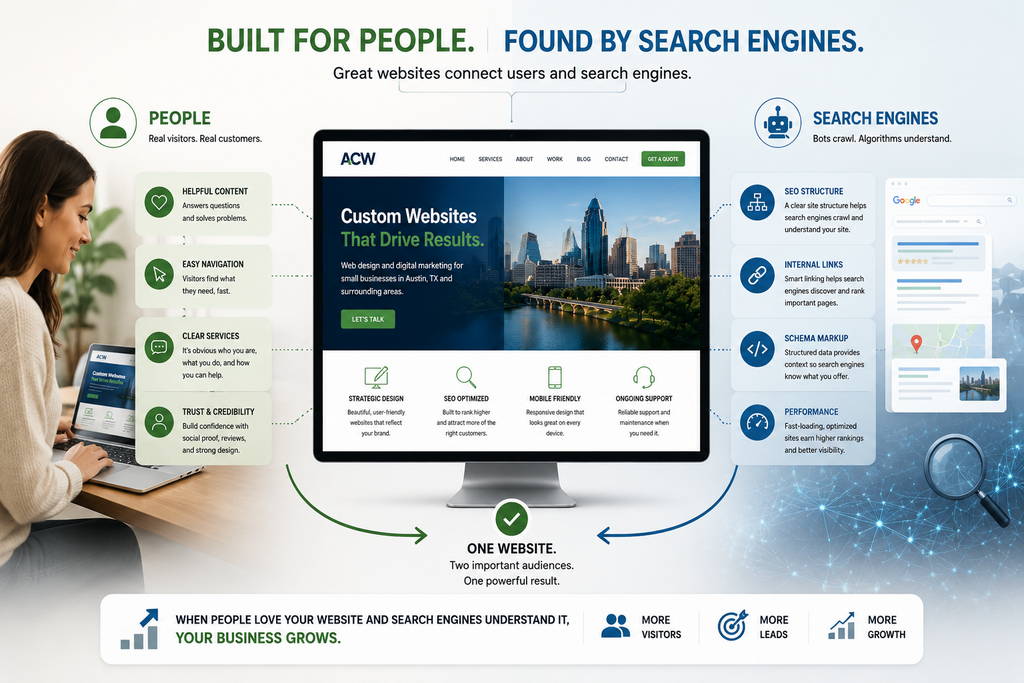
Great websites balance two audiences: the people visiting the website and the search engines trying to understand it. SEO-friendly web design begins with a logical site structure, useful page content, descriptive headings, strong internal linking, optimized images, appropriate metadata, and technically sound development.
Search engines should be able to understand what services the business provides and where it provides them, while human visitors should be able to find the same information naturally. For an Austin business, that may also mean developing dedicated service and location content that answers real questions potential customers are searching for locally.
Combining good web design with an ongoing digital marketing strategy creates a much stronger foundation than trying to add SEO after a website has already been built without search visibility in mind.
Speed and Performance Matter
A beautiful website loses much of its value if visitors have to wait for it to load. Website performance affects user experience, conversions, and search visibility, making speed an important part of the design and development process.
Images should be properly sized and compressed, unnecessary scripts should be minimized, hosting should be reliable, and the underlying website should be developed efficiently. Performance also needs to be evaluated on mobile devices, where connection speeds and processing power may be more limited than on a desktop computer.
The goal is not simply to chase a perfect performance score. It is to build a website that consistently feels fast and responsive for real visitors.
Content Should Demonstrate Real Expertise
Strong website content should answer the questions prospective customers have before they contact your business. That includes explaining services clearly, addressing common concerns, providing useful information, and demonstrating experience through project examples, testimonials, case studies, or educational content.
This has become increasingly important as search evolves. Google and AI-powered search platforms are looking for useful information they can understand, contextualize, and confidently present to users. Businesses that publish original, experience-based content have more opportunities to demonstrate expertise, build topical authority, and become a stronger source for both traditional and AI-driven search results.
A useful website also continues growing after launch. Service pages can be expanded, new questions can be answered through articles, projects can be added, and content can evolve as the business and its customers change.
Make It Easy for Visitors to Take the Next Step
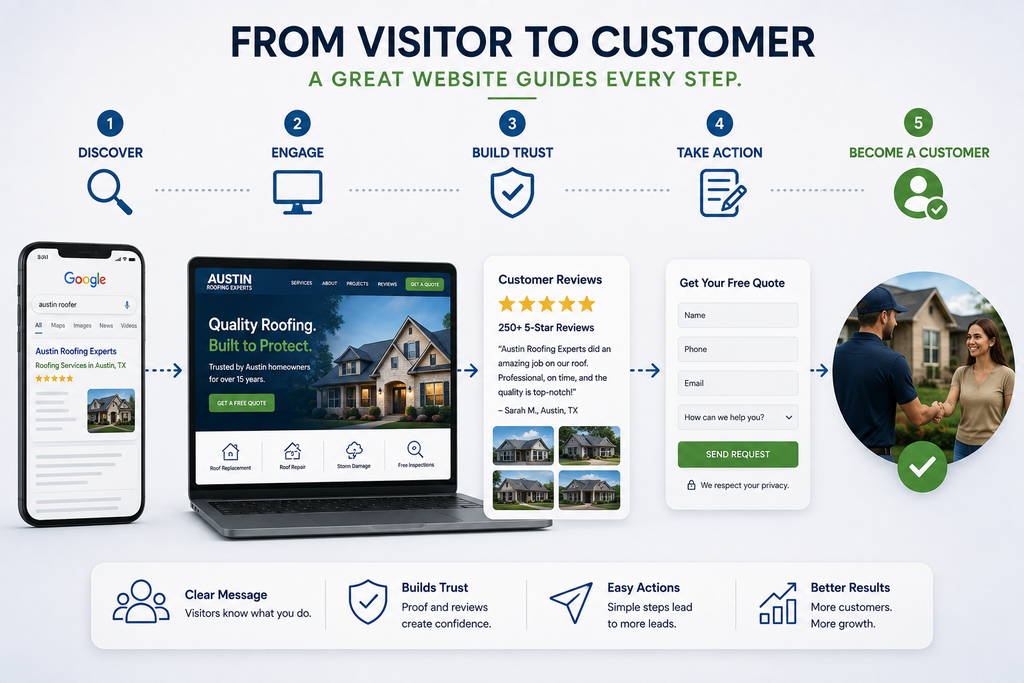
Every small business website should make the next step obvious. Depending on the business, that might mean calling, requesting a quote, scheduling an appointment, purchasing something, or submitting a contact form.
Calls to action should appear naturally throughout the website without making every section feel like a sales pitch. Contact information should be easy to find, forms should ask only for information that is genuinely useful, and mobile users should be able to call or contact the business without unnecessary steps.
This is where good design and conversion strategy come together. The website should guide interested visitors toward action while still giving people enough useful information to make that decision confidently.
A Great Website Should Be Able to Grow With Your Business
One of the easiest website mistakes to overlook is building only for what the business needs today. A website may eventually need additional service pages, locations, integrations, landing pages, ecommerce functionality, educational resources, or entirely new sections.
Building on a flexible platform and establishing a scalable structure from the beginning makes those changes much easier. This is one of the reasons we focus our website design services on long-term usability rather than simply getting a website online as quickly as possible.
For many small businesses, the website eventually becomes one of their most valuable marketing assets. Building a strong foundation gives that asset room to become more useful over time instead of forcing the business into another complete rebuild every few years. If you are wondering whether your current site is due, see how often you should redesign your website.
Final Thoughts
A great small business website combines professional design, clear messaging, mobile usability, speed, SEO, useful content, and a strong conversion path. None of these elements operates completely on its own. The best results come from designing them to work together around the needs of both the business and its customers.
For Austin businesses in particular, a professionally built website can become an important competitive advantage in crowded local search results. If you're planning a new website or wondering whether your current site is doing everything it should, contact Austin Custom Web and we can help evaluate the best path forward.
FAQs
What should a small business website include?
A small business website should clearly explain what you do, who you serve, why customers should trust you, and how to contact you. Most small business websites need a homepage, a page for each main service, an about page, a contact page with a simple form, and proof such as reviews, testimonials, or project photos. Helpful content that answers common customer questions builds trust and supports SEO. Every page should make the next step obvious, whether that is calling, requesting a quote, or booking.
How many pages does a small business website need?
Most small business websites need at least five to ten core pages, though the right number depends on your services, service areas, and the searches you want to show up for. A typical starting point is a homepage, about page, contact page, and one page for each main service. Businesses that serve several Austin-area communities or offer many distinct services often benefit from more pages, each built around a real customer search. A few strong pages will outperform many thin ones that repeat the same content.
What makes a small business website rank well on Google?
A small business website ranks well on Google when helpful, original content, solid technical SEO, and strong local signals work together. That means pages built around what customers actually search for, a clear site structure, fast load times on mobile devices, and accurate business details. Local businesses should also keep an optimized Google Business Profile, earn genuine reviews, and earn links from relevant local sources. No single trick drives rankings. The combination, maintained over time, is what builds visibility.
How do I know if my business website needs a redesign?
Your business website likely needs a redesign if it looks outdated, works poorly on mobile devices, loads slowly, brings in few leads, or no longer matches what your business offers. Other signs include a platform that is hard to update, recurring security issues, or a site your team avoids sending people to. A redesign also makes sense when an older platform blocks improvements to SEO, speed, or functionality. A careful website redesign keeps the content and rankings you have earned while fixing what holds the site back.
Can a better website actually generate more leads?
Yes, a better website can generate more leads, often from the same traffic you already receive. Leads grow when qualified visitors can quickly understand your services, trust your business, and take action. Clearer messaging, faster pages, better mobile usability, strong calls to action, and simple contact forms all make it easier for visitors to reach out. A website that also ranks for the right local searches brings in more of those visitors to begin with. Together, these improvements turn your website into a steady source of new business.
Does a small business website need a blog?
A blog is not required, but it is one of the best ways for a small business website to show expertise and reach more customers through search. Each helpful article answers a question your customers are already asking, which gives Google and AI search tools more reasons to show your business. Articles also give you useful content to link to from your service pages and share with customers. A few strong, useful posts will do more for your business than a long list of thin articles written only for keywords.